Thursday, 30 May 2013

Review Style

I'm reviewing my style :)

In most books, the author wants to bring up issues our society is facing.
While it is enjoyable to read a book, it is also important to understand the underlying issues that prompted the author to pen the book.
Refraining from being preachy, in my reviews I will discuss these issues and provide a synopsis of based on facts between the lines.

Of course I will also review the books :)

Friday, 22 March 2013

Our lady of Alice Bhatti

Author – Mohammed Hanif
Publisher – Vintage
Rating – Excellent
A satire on the misfortunes of a country brought on by it’s bigoted and egocentric males! As a feminist and prejudiced against a particular neighbour, I found green pastures to feed my previously held views. However on reflection I find that the condition of women highlighted in book is true for most all societies and especially in India. Incidents of crime against women with eve teasing, acid attacks, domestic violence, rape, honour killing, infanticide, child labour are as prevalent in India as in Pakistan.  The book also highlights caste and religion based prejudices. A drain cleaner  is called a “choochra” and a Christian sweeper, a “Yasoo choochra”. I was in the park the other day smiling beatifically at children playing catch. When I heard some shouting and running “Dong ghar ki bachi” –“child of the caste that burns the dead” . From the lips of babes my illusion of “My India is much better” was shattered!  
But all these serious issues aside, the book is an enjoyable read.
So to the story – Alice Joseph Bhatti is the daughter of Christian sweeper and manages to rise above her squalid surroundings and become a junior nurse at the Sacred hospital. But not before she spends 14 months at the Borstal Jail for causing grievous bodily harm to a doctor for wrongly accusing her of medical negligence. In her male egoistic society, Alice has seen too many cases of women honour killings. To avoid becoming one she is demure and humble in all her dealings with men. However, when forced for sexual favours at gunpoint she slashes the favour peddling member with a surgical blade than submit to humility!
With that starts her insecurity as the influential family is out looking for revenge. She thinks she will be safe with a police tout and marries him. For the muslim man though it is difficult to adjust to a head strong woman who dares to be herself in his presence. He expects unquestioning obedience, not questions asked on any tenet he holds dear or has become dear after marriage.   
In the meantime, a still born child in Alice’s watch is miraculously revived when Alice prays at his bedside. News of the miracle spreads and no-hope cases flock to the Sacred for Sister Alice’s prayers. An expecting mother at this stage, Alice’s maternal instincts are at it’s height and she wants to adopt the miraculous baby who’s mother died during the miracle. Like a lioness she also instinctively feels that her child is not secure near her husband. She takes shelter in her head nurse’s home who convinces her to return home.
Her husband meanwhile returns home, sees the empty cupboards and realises that Alice has walked out on him. Without talking to her, he seeks to revenge for the slight to his honour. Goaded by his reporting police officer who in turn is friends with the slashed favour peddling family, he decides to throw acid on her. Half a litre of sulphuric acid is thrown on an unsuspecting Alice while she is on duty and as per her father, Joseph Bhatti, half a dozen members of the psychiatric ward and a dozen other denizens of the hospital watching an apparition of the holy mother Mary on top of the Sacred. Alice dies of her injuries and as her father ascends to heaven with the Holy mother seated on a throne of peacock features. The church however refuses to consider Joseph Bhatti’s application for her sainthood on grounds that the witnesses are unreliable and Alice Bhatti’s questionable past.
A tragedy made readable by the author’s art in dark humour. The reader does not weep gallons but is still forced to consider the injustices in society.
This was my first book by the author and I can’t wait to get my hands on his other critically acclaimed book – “A case of exploding mangoes”

Tuesday, 29 January 2013

Tales from Firozsha Baag


Author – Rohinton Mistry
Publisher – Penguin Books
Rating – Very good
An excellent book of short stories with intertwining tales. I enjoyed the poetry and richness in language. The stories deal with the daily business of life and even in sadness makes one look ahead with hope.
As the title suggests, the stories revolve around the denizens of Firozsha Baag, a middle class Parsi dominated colony in Mumbai.  The trademark mad hatterness, evident in the names the denizens give each other , largesse, unforgiving truthfulness and strong family ties of the Parsis is evident in all it’s characters.

From Pesi  Paadmaroo,  his jovial but disappointed dad Mr. Modi, Rustomji curmudgeon and his much younger but tactful, pious and dutiful wife Mehroo, locality bard Nariman, silent and observant Jehangir, his loving, tactful and later controlling mother, mad Khorshedbai , lonely Tehmina and Najamai.
All characters offer a kaleidoscope into life which is at once mundane, sad, hopeful, striving and humorous.


Thursday, 6 December 2012

The girl with the golden parasol

Author in Hindi – Uday Prakash. Translated in English by Jason Prakash
Publisher – Penguin Books
Rating – Good
A book translated from hindi to english, it is closely knit with the Hindi heartland and it’s teeming problems of corruption, casteism and petty politics. The story is like a beehive of lots of individual stories held together with the protagonists’ desire to lead a life of dignity.  
Rahul is a university student at a college in MP and a hostelier. The hostel residents are terrorised by local goons who have political, police and college administration backing; who incidentally are all Brahmins and do not look kindly at other castes. The local goons target Sapam Tomba, a student from Manipur. They rob him, try to sodomnise him and make him pee on the heater. Unable to bear the cruelty, Sapam commits suicide. The hostel students vow to protect themselves since the college administration does nothing; are in fact hand in gloves with the entire nexus. They form their own group and next time the goons come, they trash them and hand them over to the police. However, the miscreants are soon out on bail seeking revenge.
In the midst of all this, Rahul falls in love with Anjali Joshi, daughter of a cabinet minister. The love story flows like honey through the beehive, soothing yet dangerous in it’s capacity to provoke violence in the gatekeepers. The goons have direct contact with her brother and she reports to Rahul that the goons will be after them. 
Soon, there are incidents of hostel students being beaten out at different public places. The local newspaper runs defamatory articles on the students accusing them of inciting violence in the city. Police raids the hostel and arrest two students who are cruelly beaten up.
At times rhetoric, the book cruelly shakes one out of the limbo of metropolitan living and shows what 80% of India is facing.  How casteism, corruption, greed, favouritism is eating up India’s youth – their dreams, their loves. After such harrowing experiences, what dreams are these students left with? Will hope still live on; will they  join the same system which oppressed them or will they take up arms to defend their ideals? The book forces the reader to ponder.
The author - Uday Prakash

Thursday, 22 November 2012

Jaya. An illustrated retelling of the Mahabharata


Devdutt Pattanaik
Author – Devdutt Pattanaik
Publisher – Penguin Books
Rating – Highly recommended
Having read modern mythologies based on older mythologies and warped fiction on speculations, it was a breather to read a “simple” retelling. To keep it “simple” requires a MASTER and I salute Devdutt Pattanaik for this feat. The monumental task of keeping the fabric of the Mahabharata plot intact while also telling the numerous tales within the tale explaining the consequences of Karma, ancestry,  social hierarchies, practices and prejudices, relationship between vedic and non vedic tribes has been done beautifully.

Vyasa narrating the Mahabharata to Ganesha. An illustration from the book.
Of special mention is the Bhagavad Gita section. I’ve tried reading the Bhagavad Gita before but a literal translation is extremely difficult reading. Pattanaik’s  retelling of the “song of God” is in understandable English. Light readers beware though, despite the simple language, this is heavy stuff! The philosophical discourse has formed the basis of faith of millions of Indians. Though at times I couldn’t help but wonder at Krishna’s cleverness - this is the tongue of a clever statesman goading his best fighter to battle.  So many times in battle Krishna goads the Pandavas to break rules of war by offering a different point of view. Does this signify that to God there are no rights and wrongs? That there is only a flow of the universe and God’s work is to ensure this flow.

Krishna delivering the Bhagavad Gita to Arjun at the scene of battle. An illustration from the book.
This was a special time though and humans who manipulated nature and accomplished grand feats were worshipped. Balarama with his plough created canals from the river Yamuna to Gokul to water it’s orchards; Krishna argued that the mountains which stopped the rainclouds over their land and thus brought rain be worshipped rather than the rain; land was reclaimed from the sea to build Krishna’s Dwarka.
The footnotes explaining historical and philosophical significance even speculations are great especially as one tends to get lost in the fantastic tales in the maha tale.  The sketch illustrations are cool! J
As an animal lover a footnote struck me.  “Dogs represent attachment and bondage because they are territorial and possessive of their masters. They constantly seek attention and validation. They therefore become the symbol of neediness, insecurity, attraction and ego.” In this Kaliyug, we love our dogs. All characteristics mentioned above are why we love them.  Forced me to reflect – Is our times an embodiment of all that was abhorred in the Vedic times?
Small footnotes besides, the Mahabharata is a tale where there are no winners. Even though the Pandavas win in battle, all of them except Yudhishtir go to hell. While the Kauravas loose in battle, they enjoy heaven with the Gods. While Krishna is elevated to the stature of a God, he is cursed by a mother, looses all his family, clansmen, beloved Dwarka and dies alone by the arrow of a simple hunter.  The Mahabharata is not the tale of two families fighting for a piece of land. It is a moral tale to illustrate how the powers of Maya bind us. How what is right in one circumstance is wrong in another. While we think we are most attached to persons and possessions, it is to our judgements, prejudices and ego that we most tenaciously hang on to. The tale however, is a victorious tale. Not of victory in the materialistic plane – because there is no victory there but of victory over the self – “Jaya”. 
The only turnoff in the book is that the pages are scented! who does that! I love the smell of a book. To have some perfume waft out is distracting and irritaing.

Sunday, 4 November 2012

The Krishna Key

Title – The Krishna Key
Author – Ashwin Sanghi
Genre – Thriller
Publisher – Westland Ltd
Rating – 2/5

Ashwin Sanghi

When I read “The Rosabal Line”, I thought it was a poor imitation of the Dan Brown’s “The Da Vinci Code”; when I read the “The Krishna Key”, I thought it was a poor imitation of “Angels and Demons”. The parallels between “The Rosabel Line’ and “The Krishna Key” are unmistakable.  Even if an author is writing in a particular genre, the author needs to innovate! Both books feature an age old mystery based on religion in which 21st century people get involved. In “The Krishna Key”, various professors of history and archeologists with radical views explain the plot’s historical and mythological significance throughout the book. While this explains the background, it hampers the pace and after a point becomes plain irritating. 
The death of Anil Varshney, a linguist and symbolist who was working on deciphering an ancient seal found at the Indus Valley site, sets the local police humming. Their prime suspect is Dr. Ravi Mohan Saini, a professor at St. Stephen’s college, Delhi.  Dr Saini is suspect because he had met with his friend on the day of the murder and the murder weapon found at the site – a scalpel with the inscription R M. 
In true C.I.D style, the police led by Inspector Radhika Singh barge into Dr. Saini’s class and declare his arrest warrant. While a shocked Dr. Saini, accompanied by his dedicated doctoral student Priya, is being taken by the police, he recounts his last meeting with Anil Varshney.  Varshney had claimed the arid Rajasthan dessert to be the site of a great civilisation around the river Saraswati. He had entrusted a seal and an encrypted note to Dr. Saini. He had also told Dr. Saini that identical three seals had been found and sent to three of their closest friends. All four seals on their base-plate, which Varshney had procured, would provide the key to unlocking Krishna’s mythology.

The actual three headed seal and some pottery discovered at the underwater city of Dwarka
However the murderer who believes himself to be the tenth avatar of Vishnu i.e. Kalki in Kalyug had conveniently placed himself as the driver of the jeep in which Dr. Saini and Anil Varshney were travelling. The killer egged on by the elusive Mataji goes on a rampage killing the other two trustees of the seal and also manages to procure the base-plate. However even with access to privileged information on the Krishna legend, the killer – Tarak Vakil and Mataji cannot still decode the Krishna Key. But why are the killers in search of the Krishna Key? The answer lay in the finding of the Syamantaka – a stone with alchemic properties capable of producing a hundred and seventy pounds of gold each day! The quest is on by two parties – Dr. Saini, his doctoral student Priya and Inspector Radhika Singh on one side and Tarak Vakil and Mataji on the other.
The quest leads the parties through Somnath temple, once the abode of the Syamantaka from where it was taken by Mohammad Ghazi to Afghanistan, to Mount Kailash – believed by the seekers to be a man made pyramid and the possible current abode of the Syamantaka, to the Taj Mahal – believed to be the alternate current abode of the Syamantaka.

Somnath temple
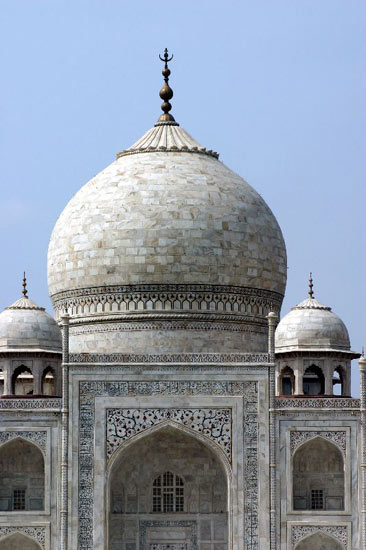
Taj mahal with Kalash cupola
Pyramid shaped mount Kailash


As thrillers go, we have an imposter. Priya and Mataji are the same and she shows her true self when she thinks she has all the information she needs in her quest for the Syamantaka and leaves with Tarak Vakil for Mount Kailash, closely followed Dr. Saini and Radhika Singh. In true Bollywood style, a life endangering situation at Mount Kailash brings Dr. Saini and Radhika Singh together as lovers. So while they do not discover the stone they do find love. The duo head back to Agra in quest of the stone.
However love enables Dr. Saini to view the quest from a more philosophical angle aided by the saying of mysterious sadhus repeating that the philosopher is more important than the stone. The alchemy they discover is not in turning base metals to gold but in turning the base metal of the human heart to gold through Love!
Even if one reads through the never ending historical discussions and theories of ancient Indians practicing embryo implants, aeroplanes, reclaiming land from the sea to build a city and harnessing nuclear sites, the philosophical ending is a big let down.  All this running around... and then the learned professor is content to enjoy the sunset at Taj with his new found love!
While the book fails to meet expectations, it hounded me enough to make enquiries (of course on the net) on the veracity of Sanghi’s claims in the book. I read through various accounts of the Saraswati valley excavations and underwater explorations for the lost city of Dwarka. A river Saraswati did flow around the time of the Indus valley civilisation but whether this settlement was part of the Indus Valley civilisation or a vice versa is still being debated by archaeologists. Evidence of the city of Dwarka found through underwater explorations of the city off the coast of Gujarat is undeniable. As written in the Mahabharata, the city was built on land reclaimed from the sea; proven by building blocks used for the city discovered!
Map of the Indus valley and Saraswati civilisations

Underwater explorations of the submerged city of Dwarka

Friday, 26 October 2012

The Little Friend

Author – Donna Tartt

Genre - Thriller
Publisher – Vintage Contemporaries
Rating – 3/5

A book rich in prose and poise but oh.... so much anger and vengeance, I had to keep asking myself why I was reading this book.  I felt like a bystander to a road accident held in a trance by the tragedy, looking on, eyes and limbs refusing to do otherwise.
The murder of a nine year old boy in his own backyard while his family prepared for mothers day dinner shocks the town.  But while the town slowly comes to terms with the murder, the family members never do. The worst casualties as usual are the children. Robin's two sisters, grow up facing their insecurities all alone. Their mother becomes a recluse in her own house; their father takes up a job and a mistress in another town. Their grandmother and great aunts stay close and fill in for the absentee parents as much as they can. Their steady companion though is Ida, their coloured house-keeper. A presence at once warm and formidable, her stories and prejudices colour their imagination. Allison grows up to be a wish-o-wisp kind of young lady seeking refuge in sleep while Harriet is a rebel.  Harriet tries to pierce together Robin’s murder from her grandmothers who refuse to say anything, from her mother and Allison who clam up, from newspapers which offer only sketchy accounts. Only Ida speaks to Harriet on the matter. Her information though is based on personal views rather than facts. Ida blames Danny Ratliff, one of the poor whites in town for Robin’s murder.  To a child however, this straw of information is the red line, the truth at last now etched in stone. One summer, having totally convinced herself on the matter, Harriet goes out seeking revenge.

 
A tragic story of neglect of children and how the refusal of elders to face up to a tragedy can affect their young ones.  A child needs to be talked to, given colours to colour their imagination and pickets to build their boundaries. When none are provided, children turn to any source which will provide them understanding irrespective or right or wrong.
Harriet almost murders an old woman with a cobra and gets herself almost killed when she unwittingly steps into a family drug ring in her quest for revenge. As Harriet is lying in the hospital she learns from her parents that who she thought and targeted as Robin’s murderer was actually his friend!  Trigger happy, drug dealing, white trash yes, but a friend never the less!

Slow reading at times, the book touches a raw nerve especially in a young parent. How vigilant must one be with the young ones.  While it is important that the adults lead their lives, it cannot be without the young ones’ inclusion. Only providing a house, food and scholarly education is not enough, it is important to tend to them, to hear their anxieties, to ensure that they know and appreciate their protective environment and respect their boundaries for their own safety.
While the book is beautifully written, there is a typecast of charectors that is hard to miss – Coloured peoples prejuidice for poor whites, Trigger happy-domestic violence filled upbringing of poor whites, Moneyed whites preoccupation with proper behaviour in society and tight lipness of anything emotional.  The author’s message in the book is not typecasting typecasts but in giving the message, the author has unwittingly followed stereotypes herself.